Thursday, 9 August 2007

BACK FROM THE CONTINENT


Channel traffic. One ferry company has 25 crossings a day!

In English: The Dover Strait,
French: Pas de Calais,
Dutch: Nauw van Kales.
Flemish: Het Kanaal.
It is the narrowest part of the English Channel. The shortest distance is from Dover in the county of Kent in England to Cap Gris Nez, the Cape near Calais in the département du Pas-de-Calais in France, the closest point between those two countries with a distance of only 33 km (20 miles).

We went through on the 26th, during the night, which has its own charm; the moon glistened on the black water, highlighting the spray and wake. We were standing on the top deck; some seagulls accompanied us gracefully and eerily.
Dotted lights all over the Channel, Ferries still crossing, boats waiting, sloops fishing, some intrepid sailors yachting, yes a very busy place!
The lights of Dover receding, those from France getting closer, a romantic experience, special, well we enjoy those things in life...
We had left our cameras in the car, for once only wanted to savour the moment and the atmosphere, without any pressure. We were on holiday, well... partly...
I just read something very appropriate: Confucius said that the secret to happiness is:

"If you find a job that you like, you'll never work a day in your life."

On our journey back, very different, we caught the SWEET light... and even more traffic!
The light was out of the ordinary, I did not want to set my camera to 'adapt' and change the way it actually was in reality, what it was doing naturally! I took it straight, overly bright, sparkling, blinding, star-effect, even some flare. To my eyes, Nature is so beautiful, so wonderfully incomparable and varied, why do we get this ‘need’ to always tamper with it, control it, and change it?

Away from the port of Calais I spotted a yacht cutting through the oily sea, the big ships in the busy lane seem to lie in wait..


Another lovely memory in the book of my life, I came home with plenty..., beauty, love, goodness, friendship and professional satisfaction.

Hope your day is plain sailing, thanx, M, (*_*)

Thursday, 19 July 2007

A FEW OF MY FAVOURITE THINGS


These are a few of my favourite things.

Today, a snapshot of my new camera. I am over the moon, I just got the D200 as a present from Paul. This is my thank you to him, a quick shot in the studio, grey bg this time, full on flash, but that is irrelevant...
The FIRST image (a PORTRAIT of PAUL) TAKEN WITH IT!!! 1600 iso!

I was a full on film user and fanatic until a year ago. OOh yes I did have the Nikon P1 always with me, but for creative work, it was my Nikon F4s.
Then Paul decided on the Canon 5D, and I was given the D70.
I used it, in the beginning not a lot, but than, sadly one of my F4 died, it had been in hospital a couple of times, some transplants, but this was it!
So I used the D70 more and more, still very much as a film camera, not boasting about coming home with hundreds of images. Quietly happy if I came home with about 100 and had 5 good ones in there! Determined to use digital as much as possible as a film camera, I do not want to loose that discipline, of looking, concentration and focus you 'need' with film because it costs money. This is 'cost' of another level that you could be squandering? I see a lot of 'sloppy and slapdash'. But hey, that is only my opinion!

Somehow, I never really got on with that camera, no complaints, it just didn't seem to jell.

Paul came in, we were talking, I suddenly noticed this golden box on the table that said D200, I couldn't believe my eyes! I am so glad that I am not 'blasé' and still have that unbelievable feeling I remember from childhood, when I recieve a gift like this. Even after all those years, all the cameras and lenses, from Hasselblad to Zeiss, the tripods, lights, haha, loads of great moments!
The moment I held it, it felt so familiar, I found immediately what everything 'did'!
It reminds me of my F4.
I put it together with my fave lenses,
the Nikkor: 75-300
: 28-200
: 18-70
: 85mm
: 60 macro.

It is still ALWAYS a great moment, a new camera is a new partnership and a new adventure, lol
Ultimately they are only the tools of the trade! It is still the eye and the creative brain using them that will SEE and 'take' the image...

Thanx, M, (*___*)

Saturday, 7 July 2007

THE MERCATOR, THE MOMENT AND THE WHY.


For more images of this UNIQUE event: click HERE


Photography is often the recording and eternalising of important, sometimes golden moments. An image can easily conjure up more than what your eyes see; you relive the emotion of that instance, the sounds, the smells and sometimes even tastes, like here, the salt on my lips. That is what the photographer experiences, but what about the viewer? Is it just a photo of a ship at sea?
Or will the words fill in the questions and gaps? I know there is a faction that maintains that a good photo speaks for itself; however I've often experienced people's genuine interest, not so much in the how, since that is ever changing anyway, but especially in the WHY?
The circumstances, feelings and reasons for your taking it, if you then add the emotions, the image is SOLD!!!

THE MERCATOR, 75 this year (2007).

For special occasions, one of them being a gathering of tall-ships, centenaries or royal anniversaries, she'll be kitted out again.
The last men and few 'older’ gang (the only ones still in the know) are gathered, the rest are eager but choice volunteers.
The bridges are drawn. The sluices and locks are very narrow; they guide her through from the quayside. Thousands of people come and watch it, forming a row of honour to bid her 'farewell'.
Late afternoon, I sit on the other side of the harbour, on the rocks at the right pier, the other side of town, in the shadow of the lighthouse and some war-leftovers (bunkers hidden and overgrown by dunegrasses).
Nobody there, camera on tripod, fixed and focused on the point where the Mercator will suddenly appear, ready to sail stately down the entrance of the harbour, between the two piers, cheered on.
After some impatient delay, she appears at the mouth of the dock, guided by towboats, frantic activity on deck and up the masts; she's being positioned for the glorious depart...
I get my shots, but, she's now moving, gaining momentum, so am I.
I run alongside, stopping repeatedly and briefly to take another shot, but my goal is the end of the pier.
I hear the creaking and shaking ship, she's alive again, this is what she's meant for, yes, she's in her element...
She dips her bow and stern alternately the closer she gets to the pier-heads, like a dolphin finding a rhythm.

At last, she's at sea, late, the sun is going, the mist and night coming.
The Jetfoil shoots out the harbour, and makes a bow of honour to the old ship, flying a semi-circle and giving the salute by blowing the horn in passing...
Most of the fleet of smaller vessels had stopped, got out of the way, saw her off...
I photograph her for as long as I can.
This is my last shot: 'The Mercator'.

This tall ship was designed by the Antarctic explorer Adrien de Gerlache (1866-1934) as a training ship for the Belgian merchant fleet. She was built in Scotland and launched in 1932.
Technical data:
• length : 78.4 m
• beam : 11.09 m
• draught : 4.5 m
• foremast : 39 m (square-rigged)
• mainmast : 41 m (fore-and-aft-rigged)
• mizzenmast : 40 m (fore-and-aft-rigged)
• 15 sails (4 jibs, 4 foresails, 3 staysails, 2 spankers and 2 gaff topsails)
• Speed : 13 knots (24 km/h)
• Crew : 150
The “MERCATOR” is named after the famous Flemish cartographer and is rigged as a barkentine or barquentine.
A barquentine is a sailing vessel with three or more masts and with a square rigged foremast and only fore-and-aft rigged sails on the main, mizzen and any other masts, related rigs are brigantine (2 masts).
Usually the “MERCATOR” carried 15 sails with a total surface of about 1600 m². Besides being a training a ship, she was also used, mainly before WW II, for scientific observations, or as ambassador for Belgium on world fairs and in sailing events.
She carried back two Moai (giant statues) from Easter Island. In 1936 she brought home from Molokai, Hawaii, the remains of Father Damien the Flemish missionary and apostle of the lepers, who died on the Molokai Island in 1889.
On February 21st, 1940, the training ship left the port of Ostend.
After a voyage to Rio de Janeiro, the Belgian ship arrived in Boma. This was the end of the twentieth voyage and at the same time the last cruise before World War II. Early 1943, the schoolship was summoned by the British Admiralty and left under the British Flag as a “Submarine Depot Ship” for Freetown, where it stayed till August 1945. It was only on January 18th, 1947 that the “MERCATOR”, taken in tow by the “Empire Mary”, sailed on the River Scheldt again.
Nothing was left from the formerly elegant and well maintained training ship. However she was repaired in Gent and sailed again from January 20th 1951 till 1960, used as a training ship and taking part in 3 major sail-races.
After World War II, the Belgian training ship put to sea again on January 20th, 1951.
The “MERCATOR” was in service as a training ship till August 1960 and made 54 voyages altogether, during which almost all seas have been sailed on and a great deal of ports called at.
The “MERCATOR” accomplished many scientific missions and many times represented Belgium abroad. The ship participated in the great sailing races, such as Torbay-Lisbon (1956), Brest-Canary Islands (1958) and won the Oslo-Ostend race (1960).
Her last trip was to Lisbon for the commemoration of the quincentenary (500 years) of the death of infante Henry the Navigator.
In 1961 she became a floating museum, first in Antwerp, and finally from 1964 in the marina of Ostend, just in front of the city hall. She was once more completely restored between 1999 and 2000 she is now a National treasure and monument.
The hottest news this week is she’s definitely staying in Ostend, West- Flanders Belgium.

Monday, 2 July 2007

ABOUT PHOTOGENIC


My beautiful son came over for a visit.
He is happily married (steady ladies, but you can look, hihi!!!) with two lovely children.
I have captured again the essence of my son, a very kind man, hardworking, and being like me, a sensitive human being, he has had to learn to live in this harsh world and take some knocks, a bit sad about the betrayals and cynicism.
Yet always an optimist and still a bit of a dreamer.
I miss him and yes, I am proud of him, no surprises there?.
It is a scanned image of a wet darkroom print.
This has not been manipulated in any way, a slight crop off the left, comp in camera, focus on the eyes and very little dof.
I photographed enough people in my life to know if it's going to be 'easy' or difficult! Tee hee. lol. Now he is easy, because
1. he doesn't mind being photographed (mostly because he is so used to it after all these years, mmmm, not his brother, so there goes that theory, no?), so he behaves normal, he was listening to Paul here.
2. because he is one of those lucky people= PHOTOGENIC!

Photogenic.

I’ve long wondered about that phenomenon, why are certain objects and certainly people so much more photogenic than others.
They look good to me, but take a photograph and… well, let’s say, what I expected is just not there!

So a person described as being photogenic may not necessarily look as attractive in real life and a person who appears attractive in real life may look less attractive in photograph.

This phenomenon is caused by the three dimensional and two dimensional polarizing effect and could explain why a person looks "better" in 2D than in 3D or vice versa. Therefore, a person described as photogenic means he or she looks better in 2D than 3D.(says wikipedia)

Well, these two models have both the 2D and 3D factor then, because they look good both ways, lucky sods… hihi, hey wait has it got NOTHING to do with the photographer and her skills? AAWWW… LOL.

I was after VERY high contrast ON FILM, ILFORD PAN F 50, virtually no grain and a special lighting in the studio.

Have a day full of laughter, it’s good for you, and thanx for your time, Magda, (*_*)

Thursday, 28 June 2007

THE TAIL OF THE MERMAID.


The Mermaid...

I was scanning some negs, taken with the Hasselblad for an ad campaign. Now there were quite a few similar poses, which is normal as you then pick out the best, and sadly the rest get discarded, I decided to have another 'look' at them when a strange thing happened.
The moment I saw this one, I immediately thought: "Mermaid".
Now you all know by now I don't 'manipulate' my images! But hey, it was a challenge I just could NOT resist. So I constructed her tail. It took me a long time, first it was all in b and w, I felt hyper creative and selecting her new lower half, I coloured it green, well she seems to like it judging by her smile, hihi.

In the studio I had pinned up her hair, she stood for over 2 hrs, at some point I asked her if she wanted a drink, with a twinkle in her eyes she thanked me, but, aaahh, the dreaded words came eventually: "she had to go for a wee!"
No way was I going to unpin and repin all of that, plus the hair had to be the same in all the images, so we giggled to a solution, I got her a container and left the studio.
What a spunky young woman, we're still laughing.

AAAAHHH c'est dure la vie de modèle!

Have a great day and thank you for your time, Magda, (*_*)

Monday, 25 June 2007

AGAIN THE POWER OF PHOTOGRAPHY and the sadness of CYBERBULLYING.


Today I am sad, my friends... well, we all have those days, I don't think it a bad emotion, it can be healing! If you've never been sad how will you know what joy and happiness feels like, hey?

We arrived on a late Summer's day at a beautiful place in the Yorkshire Dales.
It was the first time we were there since we had lost our beloved Border Collie, Pica, a few months before..
He loved that place.
This time it was quiet and deserted, only the soft air, a few distant birds, some insects buzzing from weed to weed, and distant bleating sheep disturbed the weighing silence.
In my mind I saw him running, following the trail of a rabbit, the white plume of his tail waving above the plants like a happy flag...
My heart was aching and heavy, I didn't feel like taking photographs of the glowing rolling landscape, I walked around and came to this old broken fallen gate, the hook looked like a question mark( would I ever get used to living without him?), with just one tear, everything seemed to weep, it reflected the way I felt then and now...

Today because of upsetting ways in the behavior of some people online, the negativity and unfeeling thoughtlessness , the alienation and above all the misuse of the anonymity of the medium that is 'cyberspace' and internet, it can be magic if used correctly, but there is a dark side, a huge question mark... people start to think that they can write anything about, or to, anybody. You never know who is on the other side, it could be someone who is sick, depressed, weak.
Not everybody is strong, some daren't speak up anymore in fear of the retaliations, becoming the target!

That shakes me to the core... But then, my optimism takes over again, it's just a few and they might experience a brief small moment of attention, but ultimately they will not be the victors, of that I am convinced! I will NEVER stand for bullying, terrorism, racism, antisemitism and fascism or any other negative 'ism' out to hurt human beings!
Before you write, why not take a deep breath, read your words again with the recipient in mind? Would you dare to speak the words you just wrote whilst looking that person in the eyes? If not, don't send it...

This is not so much about the loss of our dog (although I still miss him, he lives on in my heart), as in my belief in the truth and humanity in this world... the image triggered this off, again, the power of photography! A BIG question mark and a tear...

Wish you all the best and thanx, M, (*_*)

Wednesday, 6 June 2007

IN THE SHADOW OF THE FLANDERS' POPPIES

Please do not COPY or use any of my images on websites, blogs or any other media without my explicit permission. © All rights reserved.

one
two
three
four
five
six
seven
eight
nine

'In The Shadow of the Poppies'. © Copyright Magda Indigo


Raised surrounded by the remnants of war.
In the landscape, whether it be coastal or inland.
In the people, whether it be story or silence.

This delicate flower is part of my youth,
Bright red.

The child in me attracted,
Picking it to offer or cherish, only to find it extremely ephemeral.

The young woman I became,
Lesson learnt, loved running in those colourful fields,
Not enjoying the stains poppies left on a favourite dress.

The young mother I became,
Teaching her sons,
Trying to protect them from the disappointment of the fast wilting flower, the stains, the symbolism...

Now, I'm older and wiser,
More tolerant and more intolerant.

Now, I am back, they greet me, gently moving with the wind.

I just stand; take in the beauty with a smile around my lips,
And let the echoes of the past swirl behind my eyes.


I grew up in Flanders in the shadow of the poppies(1), remembrance of the wars never far away. Everywhere you go, there are graveyards, English, American, Canadian, Polish, South-African, Australian...
As a child, it is just part of the countryside, pretty, neat rows of stones and flowers.
Then, the age of awareness comes, you want to know and understand.
The adults'd rather not talk about it, their gaze becoming distant and full of sorrow and hidden, unspoken suffering (2).
I did the whole sad route of battlegrounds, still not discovering a hidden part which I discovered just now, because they were the 'enemy'.

(3) Somehow I'm only emotionally affected by poppies when I'm in Flanders. They stir very deep emotions and create a sweet melancholy, have done so for as far as I can remember. This time no different. Everywhere else I just enjoy them, it is such a happy flower.
I can feel it especially in this image, what I was trying to describe...
I'll let the flower tell you...

Established during World War I, the cemetery holds 3,233 wartime burials. In 1956, burials from many smaller surrounding cemeteries, were concentrated in Vladslo, and it now contains the remains of 25,644 soldiers from both wars.
Each stone bears the name of twenty soldiers, with just their name, rank, and date of death specified.

PART I. (4)
In 1990 I visit this place for the first time.
The silence at this cemetery is only disturbed by birdsong and rustling young leaves.
I read at the entrance, how towards the end of the war, there was chaos and no time for decent burial. That some years after the war, they were all gathered and put in this one cemetery.
As I walk further I see a few stones with some names and numbers on,

Wilhelm-20
Heinrich-17
Manfred-19,
I can't go on,
I lift my camera, it feels heavier than ever, I push the shutter, the familiar sound is startling.
I hear murmur and whisper, I look across, an older couple are bent over, trying to clear a name, she clutches her handbag, he holds on to his jacket, finally they put a small azalea down.
If they are the parents of one of the fallen youngsters, it will be the last time they come to visit, their final farewell.
I wait until they're gone, then I take this image, one plant for all of them...

Part II. (5)
EVEN THE POPPIES CRY: ONE GIANT variegated POPPY in my garden, larger than the biggest hands and burning like flames.
The second image: The Grieving Parents by Käthe Kollwitz at the WAR cemetery of Vladslo in Belgium.
Many of the German dead in Vladslo cemetery died between 16 and 31 October 1914 during those fearsome attacks on nearby Belgian positions during the ‘Battle of the Yser’. The dozens of flat marker stones, each containing a number of names and dates of death, give proof of that. However, Vladslo is perhaps the place on the Western Front where the everlasting impact of death in war on those at home is driven home to the visitor. At the other end of the cemetery from the entrance lodge stands Käthe Kollwitz’s tribute to her dead son of 1914, the statue known as ‘Die Eltern’ (‘The Parents’).

Käthe Kollwitz, a famous German artist, devised the statues as a tribute to her lost son. After his death she admitted to a friend: ‘There is in our lives a wound which will never heal. Nor should it’. The stone parents are shown kneeling facing the cemetery. The father clasps himself tightly while the mother hangs her head in grief. Käthe and her husband, Dr Karl Kollwitz, personally brought the statues to Belgium. Of their last visit to Peter Kollwitz’s grave and the statues, she wrote:

We went from the figures to Peter's grave, and everything was alive and wholly felt. I stood before the woman, looked at her – my own face – and I wept and stroked her cheeks. Karl stood close behind me – I did not even realize it. I heard him whisper, ‘Yes, yes’. How close we were to one another then!

Käthe Kollwitz, quoted at www.rogallery.com/Kollwitz/Kollwitz-bio.htm


Part III. (6)
I entered this cemetery, lying amidst the fields, a German cemetery. Grey concrete slabs, mossed over, some cracked, dirty, mostly no names now, erased by time and wind, just mass graves.
No flowers except this lone poppy, a random gesture of Nature.

Part IV. (7)
Nearby Poelkapelle and Langemark, not far from Ypres, my journey takes me to another German Cemetery, alongside a quiet country lane, that I passed hundreds of times during my childhood on my way to a great-aunt.
I knew all the other cemeteries, like St Julien, with the impressive statue of a Canadian soldier standing with bowed head, a landmark now.

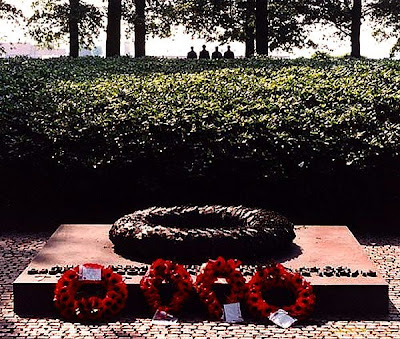
Walking through an archway, this is what you see, cobblestones, a memorial slab with a bronze wreath, a huge field of green, a mass grave containing 25.000,surrounded by oak trees and overlooked by 4 bronze soldiers. In total there's about 45.000 buried here.
I do not stay very long, it is dark and feels cold.
I'm bewildered to see the poppy wreaths.
A party of English veterans came by and lay them there. A forgiving and noble gesture.
I leave, deeply touched by the whole experience.

PART V. (8)
Tyne Cot.
It was years since I last was here. I'm not a cemetery person, this outing just happened.
Near Ypres there are numerous war cemeteries from the different nations. A large part are British. One of the largest and most impressive is the Tyne Cot cemetery, which is situated to the south of the village of Passendale.
Here can be found a total of 11.856 graves : 8.901 British, 1.353 Australian, 966 Canadian, 519 from New-Zealand, 90 South-African, 14 from New Foundland, 6 from Guernsey, 2 from the British West-Indies, 1 French, 4 German and 101 graves for soldiers whose nationality could not be determined. (all united in death)

William- 22
John-18
Alastair- 20
Shamus- 17

I read this and I go numb, the breeze feels colder, the sun hotter, I smell the grass, freshly cut and neatly trimmed each grave ornated with flowers and plants, some I never saw before.
I stand in the middle, row upon row, beautiful new patterns each time I move, this is what I saw when I was a little girl, dancing at dad's hand, blissfully ignorant of the tragedy around me, mystified about the tears rolling down his cheeks.
I stand amidst the unreal silence.
The white grave stones are being cleaned, ready for summer.
They are not forgotten.


On June 6, 1944, a date known ever since as D-Day, a mighty armada crossed a narrow strip of sea, The Channel, from England to Normandy, France, and cracked the Nazi grip on western Europe.
At Omaha, steep cliffs favoured the defenders and the US Army suffered 2,500 casualties.
Of the 23,000 airborne troops, 15,500 were Americans and of these, 6,000 were killed or seriously wounded.
Over the next couple of days 156,215 troops were landed from sea and air, at a cost of some 10,300 casualties.

WE OWE OUR LIVES today to those who fell... (9)

Throughout history war has been the source of serious moral questions. Although many ancient nations and some more modern ones viewed war as noble, over the sweep of history, concerns about the morality of war have gradually increased. Today, war is generally seen as undesirable and, by some, morally problematic. At the same time, many view war, or at least the preparation and readiness and willingness to engage in war, as necessary for the defense of their country.
Pacifists believe that war is inherently immoral and that no war should ever be fought.

For me in war there are no winners, too much destruction, pain, loss and sadness on all sides...


If there is to be peace in the world,
there must be peace in the nations.
If there is to be peace in the nations,
there must be peace in the cities.
If there is to be peace in the cities,
there must be peace between neighbors.
If there is to be peace between neighbors,
there must be peace in the home.
If there is to be peace in the home,
there must be peace in the heart.

By Lao Tzu (570-490 B.C.)

John MacArthur calls Peace: A By-Product of Faith, Hope, and Love …
Peace has many different aspects in my view; it’s not just about peace as opposed to war, but inner tranquility, peace and quiet, the absence of violence.
I’ve often felt that the only way I could contribute was in a small way, taking care that my personal world was in peace, I once read a quote by Joan Baez:
"I would say that I'm a nonviolent soldier. In place of weapons of violence, you have to use your mind, your heart, your sense of humour, every faculty available to you...” (I use my camera)
That fitted my philosophy, and I guess if we ALL followed that path, world peace would not be so elusive?

Have a peaceful day and thanx, M, (*_*)